Voyage to India

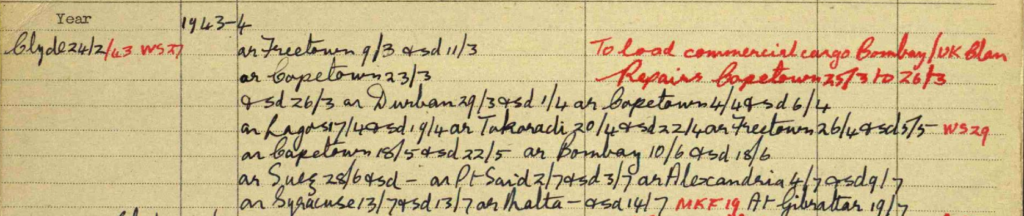
Cled’s Service Record, as above, states that he embarked for India on the 21st of February 1943 and disembarked in Bombay on the 11th of June 1943 – this length of voyage is very long for that specific journey totalling 110 days at sea.
His “INDIA” date above would be the date he embarks on ship, and it matches the timing for convoy W.S.27 exactly. This convoy was part of the “Winston’s Specials”, hence the WS prefix, and provided troops and supplies to Africa, the Middle East and Asia. The thing is, the disembark date does not match the one for which convoy W.S.27 arrived in India.
WS27 sailed in February of 1943 (so we know he was on this), it went into the Atlantic, to Freetown, then Cape Town, Durban, and then onto Aden and Bombay. The section of W.S.27 which sailed to Bombay (WS27.B) arrived there in April – Cled’s record, records him there in June!
I think I might have solved why this is the case, and I’ve got a working theory that Cled was on the troopship known as ALMANZORA.

This specific ship left in convoy W.S.27, leaving Clyde on the 24th of February, but it had issues along the way. She sailed into Freetown on 9th of March and then into Cape Town on the 23rd. Crucially she had to stop for 2 days to repair. Due to this she was separated from convoy W.S.27, which continued without her.

Almanzora stays in the waters around Africa for a bit as she goes east to Durban, arriving there on the 29th of March. Cape Town on the 4th of April. Lagos (Nigeria) on the 17th. Takoradi (Ghana) on the 20th, and is then back to Freetown, sailing into dock on the 26th of April.

At this point the next convoy, W.S.29, catches up with her and she joins it officially on the 5th of May.
W.S.29 reaches Cape Town on the 18th of May and on to Bombay, arriving on the 10th of June 1943. Cled’s disembark date is the 11th! I cannot find another troop ship that makes a journey that fits the timeline that we know of Cled from his Service Record. The Almanzora fits what we know perfectly.
If this was his ship for those months it wouldn’t have been the nicest experience. It would have been a crazy, and unique experience, but I think it would have been a struggle for a Welsh boy used to colder climates. The West African coast during those months can easily get up to 35°C with 90% humidity.
Royal Museums Greenwich website states:
“The last of a class of ships built by Harland & Wolff, Belfast, for the Royal Mail Line’s (RML) South American service. ‘Almanzora’ was launched in 1914 and commissioned in the following year, like her sister ship ‘Andes’ (SLR1410), as an armed merchant cruiser, attached to the Tenth Cruiser Squadron. She was engaged mainly in convoy service in the North and Central Atlantic.
Reconditioned after war service, ‘Almanzora’ made her maiden voyage as a passenger liner in 1920. Her first-class accommodation was elaborately decorated in the Tudor and Jacobean styles and she also had a winter garden, a new feature for a ship on the South American line. After an uneventful peacetime career, she was on her last voyage from South America in 1939 when war broke out.
She was immediately requisitioned as a troopship and during her war service, ‘Almanzora’ made many voyages to South and East Africa, later taking part in the Sicilian landings. She survived both a collision with another RML ship, ‘Orduna’, in the Red Sea, and one with a German aircraft, which crashed into her hull. Her final task was the repatriation of European nationals after the end of the war, and took part in the repatriation of Russians from Britain to the port of Odessa in April 1945. She was broken up at Blythe, Scotland, in 1948.”
Life in those months at sea would have been an endless cycle of drills, lectures, cleaning duties, physical exercise, writing letters, playing cards, reading, smoking and talking. Heat and humidity, boredom and nothing but sea for days if not weeks on end. Food would have been troopship staples like porridge, bully beef, stews, tinned meats. Very repetitive and nothing fresh.
To add to the discomfort of the journey was the ever-present threat of U-Boats in the waters. Life jackets would have had to be donned whilst doing drills and actual alarms due to threat. Smoking would have been prohibited on deck at night due to the threat, with portholes shut and painted black to obscure light – trapping the heat and the smell in.
There are numerous accounts of the ship and life on it during the war, not all of which I’ve had time to get to as yet. But one sticks out to me. The ship was in convoy a good 12 months before Cled was on it. It was night, and there was a minor collision between it and another ship. The troops, being awoken by sounds of metal, banging etc panicked and rushed to get on to deck. It was at this point that it was truly appreciated that each deck only had one stair well at each end, and it was not conducive to mad rushes to get to deck.
When the ship was at port the men would have gone ashore if there wasn’t some local quarantine/security restriction in place. Places like Durban, Cape Town & Freetown were places Cled would probably have been able to go ashore. The troops could have had free time of a sort at these locations but would also have had to do marches and parades to “keep spirits up”.

Bombay
The eventual destination was Bombay. In 1943 it was one of the busiest ports in the world and was the gateway for men and supplies going to the Burma front. The port would have been a very international affair with British, Indian, American and other Commonwealth forces all present. The harbour would have been packed with vessels of all sizes and shapes, from local fishing vessels to full blown warships patrolling and protecting the convoys.
In my research of the war in the East I found this lovely quote by a British soldier on his way to the defence of Singapore, of Bombay, which he stayed at for 1 day.
However, nothing, nothing could have prepared me for the real Bombay. We saw it at dawn the next day. And we smelt it too. We had one day to soak up the subcontinent and we swapped our English money for a handful of rupees. We were barely off the gangplank before we were surrounded by a swarm of beggars who had probably been waiting at the dock gates for hours. They were men, women, children, all of them in rags, all of them with the choking, gag-inducing smell of the starving. They clamoured for an anna, the rough equivalent of a ha’penny, and they clawed, jostled and gouged each other to reach us. Here was a blind man, eyes with no irises staring into the sky. There was a woman with only one arm, struggling against the others. Someone was jabbing me in my army belt buckle. It was a lad; what was he? Twelve? Thirteen? He had no legs and he was scooting along on a little wooden platform on wheels. It was a bit like the home-made trolleys we’d made to race each other at home, but it was nothing like that really. It was half a man’s body. First, you can’t believe it, the begging. Then you feel sorry. Then you gag from the stench and you know you can’t save them all. So you want to get away and you shout and use your elbows. It may be, and I’m ashamed to admit it, some of the lads used their boots. We were squaddies, for God’s sake. Did they think we were made of money?
At the dock gates, we all stood stock still. I was looking into the Abyss, those dark pictures of hell the vicar had described to us in Sunday School. You couldn’t see the pavements for people and we stumbled over bodies lying against shopfronts and in doorways. Were they dead, those bundles of rags? Or just asleep? And how could they possibly sleep in that cacophony of noise? Whatever they were, they were lost beyond our comprehension.
People swarmed everywhere. Buses were crammed with them, inside and out, luggage and bodies hanging from the roofs. Klaxons brayed as vehicles tried to navigate the sea of jostling humanity. Shopkeepers, as eager for our annas as the beggars on the quay, called out to us their street cries. Rice. Carpets. Cloth. Tea. I’d never seen so much stuff. There was rubbish in every corner; your boots crunched on it constantly. Here and there a scrawny cow with huge horns wandered through a market place. We just stood and stared.
If I close my eyes I can still smell those Bombay streets.
Coincidence #1
The following happens as Cled arrives in Bombay…
In the convoy Cled finally arrives in, is another ship, the Athlone Castle. This has the interesting family link of being the ship that brought Cled’s brother Will to India (he arrived on the 20th of December 1942).
As it would happen, on the day that Cled arrives alongside the Athlone Castle, Will is less than 15 miles away at a place called Aksa doing practice with 6 South Wales Borders for seaborne landings. Both men, if on deck at the time can see each other’s ship. The presence of the Athlone Castle and her distinctive lines could well have drawn the gaze of the men of the South Wales Borderers.
Cled and Will are nearly 5000 miles from Swansea and find themselves only 15miles apart.
As far as I know, they never met whilst in India. Nan told me that Will and his cousin met up, but I think this is Cecil who was in the same 36th Division as Will was.
I do wonder how much Cled and Will talked about this all when they got back home. If they made these connections… It’s funny for me, reconstructing the timeline of both Will and Cled, as there is considerable overlap in them being in places together.
India – June 1943
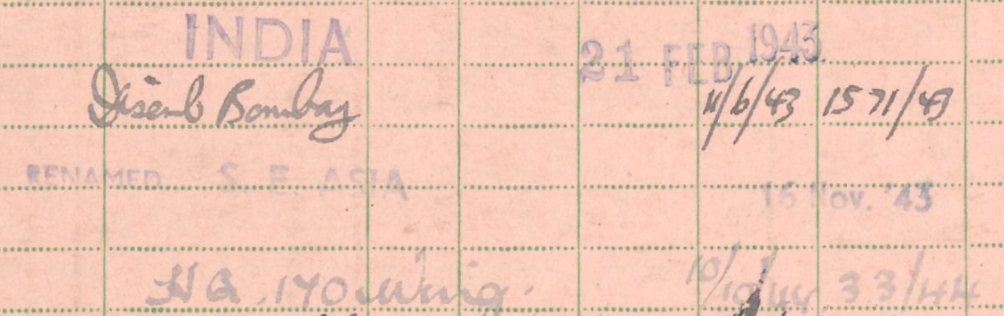
Cled’s service record simply states Disembark Bombay 11/6/43, there is no unit associated with him for his time there, and the next entry is in October of 1944 some 486 days in the future.
So, what did he do from his disembarking at Bombay to the entry on the 10/10/1944?
In the Bombay local area, you had several major RAF bases. RAF Station Santa Cruz, Juhu Aerodrome, Bombay Base Headquarters, Kalyan and RAF Station Poona are all nearby. Cled would have entered the Bombay Base Headquarters system as they had responsibility for sorting arriving and departing personnel, as well as the motor transport, stores, postal services, maintenance depots etc. Cled would have been assigned within the RAF infrastructure at Bombay and would have moved about as the task required. I think this is one of the reasons Cled’s training was so short – the men were desperately needed to move supplies around.
It is fair to say that Cled probably visited all the above-named bases as part of his driver duties, as well as the dock infrastructure and railway heads, where men and supplies were put on trains to the Burma front.
His life for the next 450 days would be one very much intertwined with everyday Bombay.
Cled’s arrival in Bombay was in the middle of the Monsoon season. Torrential rain, flooded roads, mud, heat, humidity, wet uniforms and vehicles needing constant attention. The summer monsoon period would have seen highs of the mid 30s with nighttime temps over 25°C. Relative humidity would have been between 70-90%. They would have had nearly 1000mm of rain in one month alone, around 2/3 of Swansea’s annual average.
All things combined nothing ever truly dried out, a constant state of wetness prevailed. When the humidity peaked clothes would quite literally start to rot. Due to the monsoon temperatures combined with the humidity the “feels like” would have easily been over 40°C at times. Cled would have gone through 2 of these monsoon periods whilst in Bombay, one in 1943 and the other in 1944. Winter wouldn’t have been better, the temperature would have been some 5-10°C cooler in day and night, and the humidity would have been lower. Between the two periods you had the spring heatwave with temperatures topping the high 30s°C before the rains came again.
RAF accommodation varied, but presumably he would have been in barracks within the Base Headquarters or some camp, but they could have used requisitioned buildings or been in tented areas etc.
Here is a booklet that was given out to arriving service men – Welcome to Bombay
The streets of Bombay were a noisy mix of red double-decker buses, military convoys, hand-pulled rickshaws, oxcarts, and sacred cows wandering around traffic. After a heavy downpour, the hot tarmac would steam, creating a thick low-lying fog that mixed with the smell of wet earth, open sewers, woodsmoke, and heavy spices. As a Driver, Cled would frequently have been required to navigate heavy trucks through knee-deep standing water, hidden potholes, and flooded drains that could easily stall or drown an engine – let alone the crowds of the city itself.
Bombay at the time was a bit of a political powder keg. Mahatma Gandhi had launched the “Quit India” movement from the city just a year prior. The streets experienced frequent anti-British protests, political strikes and a heavy military police presence. Being a driver would not have felt like the safest profession, at times.
Cled was promoted to Aircraftman 1st Class (AC1) on the 1st of September 1943. This marks his completion of trade training and shows he achieved a standard qualification/proficiency. He had been in country for some 80days at this point.
The end of year proficiency review logged Cled’s rank as AC1 his trade as Drive Mechanical Transport, his character as Very Good and his proficiency as Satisfactory. Aircraft-hand had been dropped from his RAF trade, indicating that his is very much aligned to the Mechanical Transport of the RAF, than doing anything with aircraft.
A thought occurred whilst writing this document. There is a fair chance that Cled never once goes in an aircraft whilst in the RAF, unless he manages to go up in some trainer aircraft post conflict in late ‘45 or ‘46. His transport to and from India is by sea, and his transport between positions in India by rail.
Great Bombay Dock Explosion
The Great Bombay Dock Explosion on the 14th of April 1944, and was a defining, catastrophic event during Cled’s time at Bombay – Cled had been in India for 277 days when it occurred.
The freighter SS Fort Stikine – carrying a mix of ammunition, cotton bales, barrels of oil, timber and gold bullion – caught fire and exploded in the harbour. The explosion shattered windows 12 miles away, levelled the entire port district and ignited a firestorm that burned for days. The sound of the explosion and the 2nd explosion that followed it were loud enough to be heard some 50 miles away. Around 1000 people lost their lives in the explosion and fire that followed it.
Debris from the ship as well as literal bars of gold rained down onto the city streets.
Cled would have been close enough to witness the events that transpired over the coming weeks even if he hadn’t heard and seen the explosion itself – he may well have been within range to hear if not see the initial action as most of the RAF bases in the area were within 10 miles!
A massive cloud hung over the city for some time after the explosion.
It took the combined effort of lots of people to bring the last of the fires under control 3 days after the explosion and some 8,000+ people toiled for 7 months to remove the ½ a million tons of debris and bring the city back to working order.
Owen
Around the time of the explosion in Bombay, 10 days after it, Cled’s brother Owen dies in Swansea. To quote the book “Devon and Beyond”:
Sadly for the family, in 1944, Owen died aged 20 following an accident playing football. Apparently gangrene set in the wound which resulted in both his legs being amputated. However, his death certificate states that he died from ‘osteogenic sarcoma’, a cancer of the bones, which perhaps indicated the presence of an earlier terminal condition. He was employed as a timekeeper in the dry docks at the time of his death.

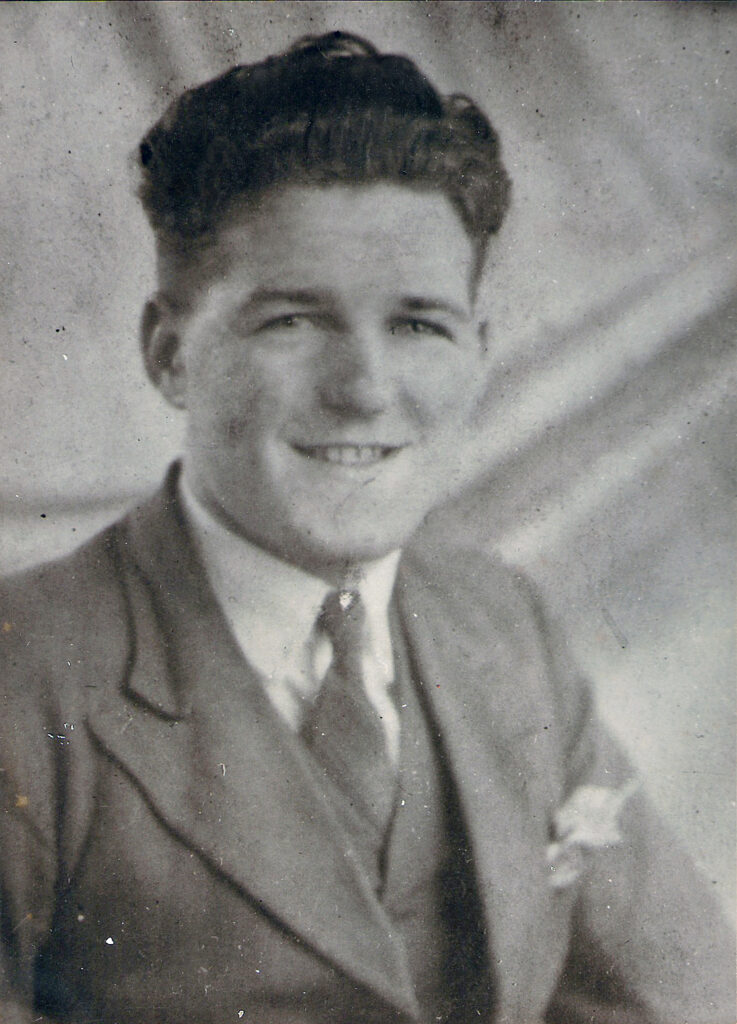
I wonder if Ben wrote to tell Cled and Will about Owen having died, or if he kept the truth away from them whilst they were away in war. There wasn’t anything Will or Cled could have done about it after all. They couldn’t attend the funeral; it would just serve as a distraction and maybe get them killed. Cled wouldn’t be back in the UK for nearly 2 years after Owen’s funeral, and the same with Will.
Ben had first-hand experience of this sort of event, as his brother Sidney had died in 1917 whilst Ben was away in World War 1. Ben had been 24 at the time when Sidney had died. Cled was 23 and Will was 25 shortly after the time of Owen’s death. So, I think Ben would have a unique insight into how he felt about news reaching him and what he’d have preferred. Maybe he even said something about it to the boys before they went off to war and and how they would deal with news of death.
The War
The war changes whilst Cled is in India. When he arrives, the Allied Forces are rebuilding after the loss of Malaya and Singapore and are trying to stabilise themselves after the withdrawal back into India, from Burma, in 1942.
The theme of the day was very much one of rebuilding strength in the theatre of war. This is why Bombay was so critical as a logistics gateway for the region. Troops, aircraft, stores, fuel, vehicles and the support structure behind the front lines came through here and onwards, usually via rail but also by road, coastal shipping, inland waterways and via air transport. The main issue for the RAF at that period was establishing a supply chain that could reach the front line and work effectively over hundreds of miles.
By mid-1943 the Allies were very much in a defensive and rebuilding phase, along the Assam/Bengal line and holding the Burma frontier. The RAF would have been conducting reconnaissance, supply flights, protecting India as well as supporting the Army. Cled and the ground crew like him were the infrastructure that made flying at the front lines possible.
As 1943 progresses offensive preparations begin. The Allied air forces focus on improving fighter capacity and strength, building transport capacity and improving airfields. Slowly but surely the preparations turned in to action. Air superiority increasingly shifted towards the RAF and Allied Air Forces, which allowed a more active role targeting Japanese supply lines, railways, river transports and staging areas.
As 1944 starts the Japanese make a last throw of the dice and try and launch Operation U-Go, the invasion of India. Their targets at the time are places called Imphal, Kohima and the Assam supply route.
All efforts turned to stopping the Japanese advance and to keep Imphal and Kohima supplied so they can hold out.
March-July 1944 marked the Battle of Imphal and Kohima.
The fighting around Imphal is over by July, the Japanese offensive fails, their push for India is over. Over the coming months the Allies begin their advance back into Burma and by early 1945 the push is underway.
The RAF’s ability to keep Imphal supplied by air became one of the decisive factors of the campaign and depended on thousands of personnel behind the aircraft: drivers, mechanics, armourers, signals and supply personnel.