Introduction
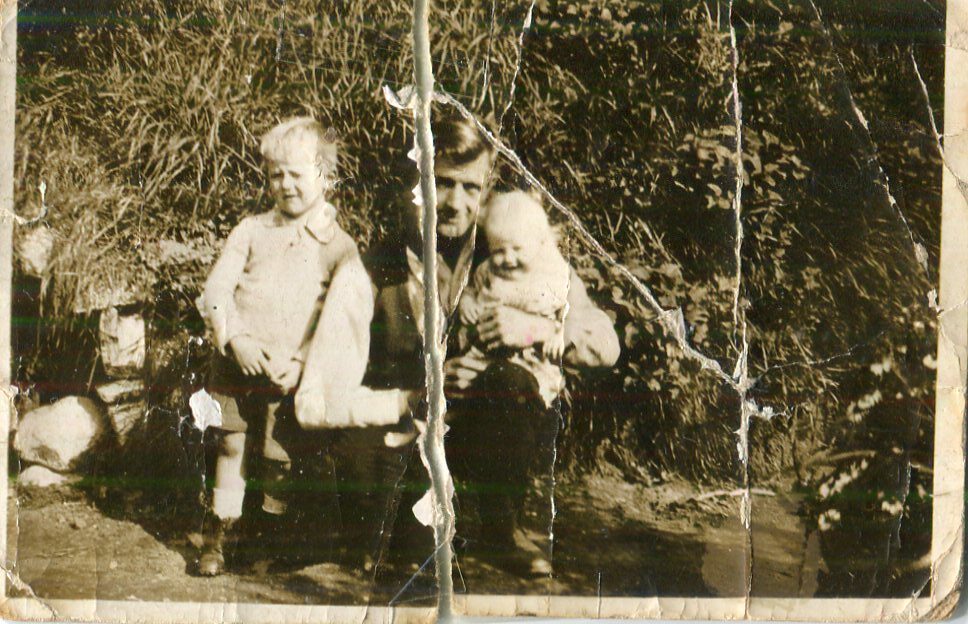
Benjamin Cledwyn Littlejohns, born 23/12/1921, was the second son of Benjamin & Margaret. Sibling of William John Littlejohns (born 25/4/1920). Joshua Owen Littlejohns, known as Owen (born 23/3/1924) and Margery Littlejohns (born 6/2/1926).

I’ve found the name Cledwyn interesting ever since I got into family history back in the early 2000s. Cledwyn is the only name from Ben’s kids that really sticks out to me. William, John and Joshua are all family names (Ben’s brothers).
Cledwyn is quite a rare name.
-There were less than 60 Cledwyns registered with that as their first name born between 1837-1900.
-There are fewer than 20, as a first name, registered in Swansea (town&city) from 1837 to the present.
-According to the official UK Birth Register, the first 5 Cledwyns ever registered in the UK were born in 1849, 1851, 1876, 1877, 1878.
So, it really is not common by any means by the time our Cled is born. In the 1921 Welsh census, there are only 212 Cledwyns (first or middle names) out of a population of 2.6million.
Ben had moved to Swansea from Clovelly in the early 1900s, and the choice of name has always made me wonder: did Ben know someone local with the name whom he held dear? Or maybe during his World War 1 service in the 9th Battalion Welch Regiment, he had met someone of that name?
Sources
The following document was put together by stepping through Cled’s RAF Service Record. This was obtained from The National Archives this year (2026), and this document represents a first parse through the history that is available to us.
As time goes on, there will be more digitised records from the Second World War made available. Many of the records are currently sealed as there are restrictions on their release. Personal records, for instance, are covered for 115 years from the person’s birth. The unit diaries of the World War 1 units were digitised and put online for the 100th anniversary of the War, and I expect the same to happen the closer we get to 100 years from World War 2.
This website entry is intended as a jumping off point for further research, and I hope to update it as new information becomes available to us. This is the main reason I wanted to do it as a website, so it isn’t set in stone.
In the Archives, there is the distinct opportunity of finding pictures of Cled and the units he was stationed with, the places he stayed and more info that could help us fill out a day-to-day story of his WW2 experiences. On top of this, there are video and audio records in The National Archives and Imperial War Museum that would feature places and units Cled was with. It all combines to give us quite a good picture of what Cled was up to whilst enlisted in the RAF.
So, what do we have available to us at the time of writing?
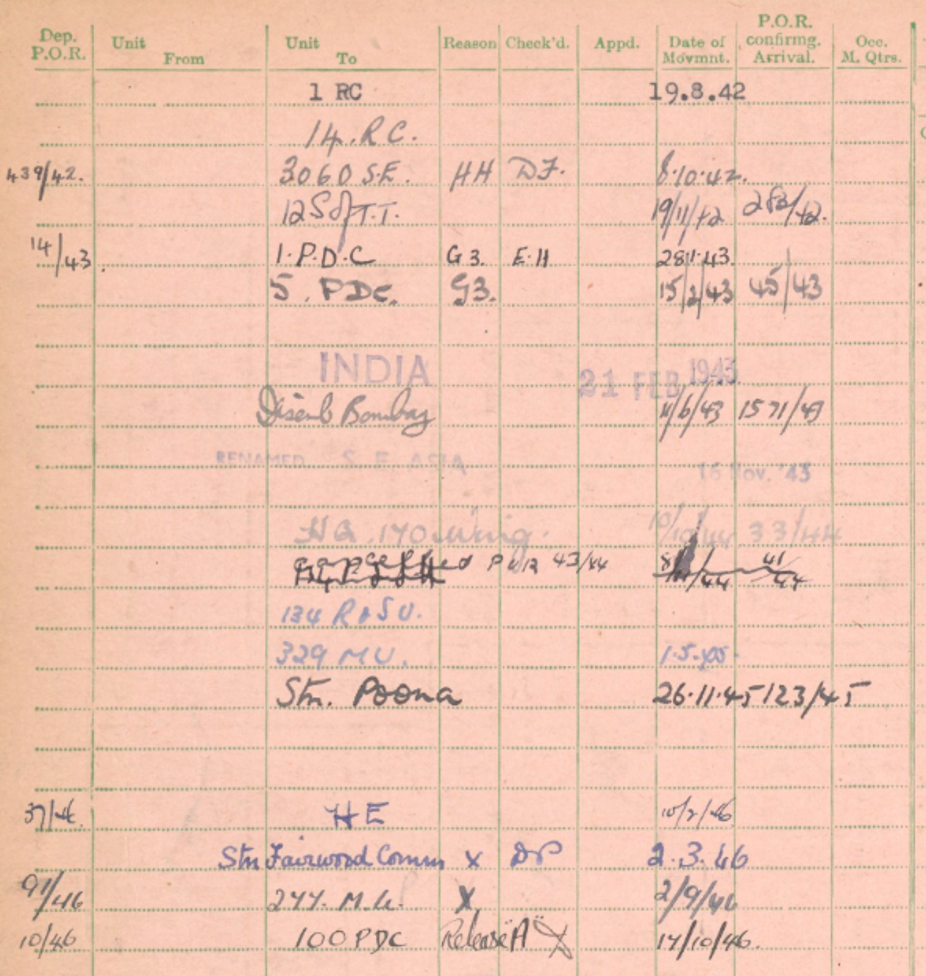
The above image is an excerpt of Cled’s Service Record. It is completed by units and stations that Cled was with. The image represents the individual units Cled was assigned to and a skeletonised timeline of his movements from enlistment in 1942 through to the end of his service in 1946. The main part is the column that shows the unit he was transferred to, often written in shorthand and abbreviations, but it does include the date of the change to the record, as well as a reference to the order or P.O.R that enacted the change.
I remember reading that bit for the first time way back at the start of this research and exclaiming “Cled went to India?!?!”. I had no idea up to then that India was to be such a feature of his service.
1942 – Enlisting and the RAF
On the 19th of August 1942 Benjamin Cledwyn Littlejohns enlists in military service, with the Service Number 1661836, as part of the Royal Air Force.
At the time of enlisting, he is 5’8½” with a chest of 32 inches (Will is 5’7” with a chest of 33”). He is noted as being fair headed, blue eyes, a fresh complexion and with 2 vaccination scars on his left arm.
His next of kin is his dad, Ben, given as “Mr B Littlejohns, Rhydydefaid, Killay, Swansea”. His religion is noted as being Baptist and he is permanently employed in Industry.
It is interesting to note that both Cledwyn and his brother William marry in 1942, brothers marrying sisters. Even though Will had been in the military for a few years to this point, he is married in a civilian suit. Cled, however, gets married in RAF uniform.
I imagine Will knew he was going abroad and soon, so he may have wanted to get married, dressed as a civilian. Cled was newly enrolled in the Royal Air Force and possibly didn’t know that he was going abroad. Different approaches from different brothers, or perhaps, different sisters.

Enlisting
As part of the enlistment process into the military Cled goes through the medical assessment and is judged to be:

As such he was marked as “Not suitable for training as an ACH/FM E or A”. Aircraft-hand / Flight Mechanic (Engines or Airframes). Due to this medical issue with his feet Cled was officially ruled out from training as an aircraft-hand or flight mechanic, as those roles required long periods of standing, climbing over aircraft etc.
The record doesn’t specify exactly what was wrong with Cled’s feet other than the line above. From researching this it could have been flat feet, high arches – something specifically with the load bearing ability of his feet. It could have been from a previous injury, broken bones, damaged ligaments etc. Nothing severe enough to classify him as disabled, but enough that it downgraded him from certain work.
At the time of entry into the military his official role is recorded as ACH/Driver MT – which means that he was a Driver of Mechanical Transport. As a driver, Cledwyn would have been responsible for the driving and basic maintenance of Mechanical Transport (MT). MT in this sense is any vehicle the RAF could get their hands on during World War 2.
Ben
I was once told a story by Nan, that said that Ben had driven the first bus on Gower! After doing a bit of research I can see that on the 10th of July 1915 Ben Littlejohns (Penderry Cottage Upper Killay) was given “a license for motor buses to replace horse buses”. So, the story seems true! I’m not sure how long this lasted as World War 1 presumably interrupted it. Ben (with the service number 61576) was likely called up around the end of 1917. We know he was there at least in 1918 because he was wounded on the 29th of April 1918.
At the time of the 1921 census Ben’s occupation is given as General Haulage Lorry Driver, the family are living at Oakley House, Killay. When Ben is married a 2nd time in 1936 he is recorded as Lorry Driver (Haulage Contractor). The 1939 census records him as being a Lorry Driver. At the time of the census the family are living at Rhydydefaid Cottage in Killay. William is listed as a cable laying labourer for the Post Office. Cled is down as a Brickyard worker and Owen is just listed as a labourer (boy). I think Margery’s record is still classed as “closed” so the listing doesn’t show.
I think it’s fair to say that Ben’s children would end up learning a thing or two about driving and fixing vehicles because William was in the Motor Transport Section of 6th South Wales Borderers. Cledwyn was a driver of Mechanical Transport for the RAF. Margery was Auxiliary Territorial Service (ATS) but assigned to the Royal Army Service Corps.
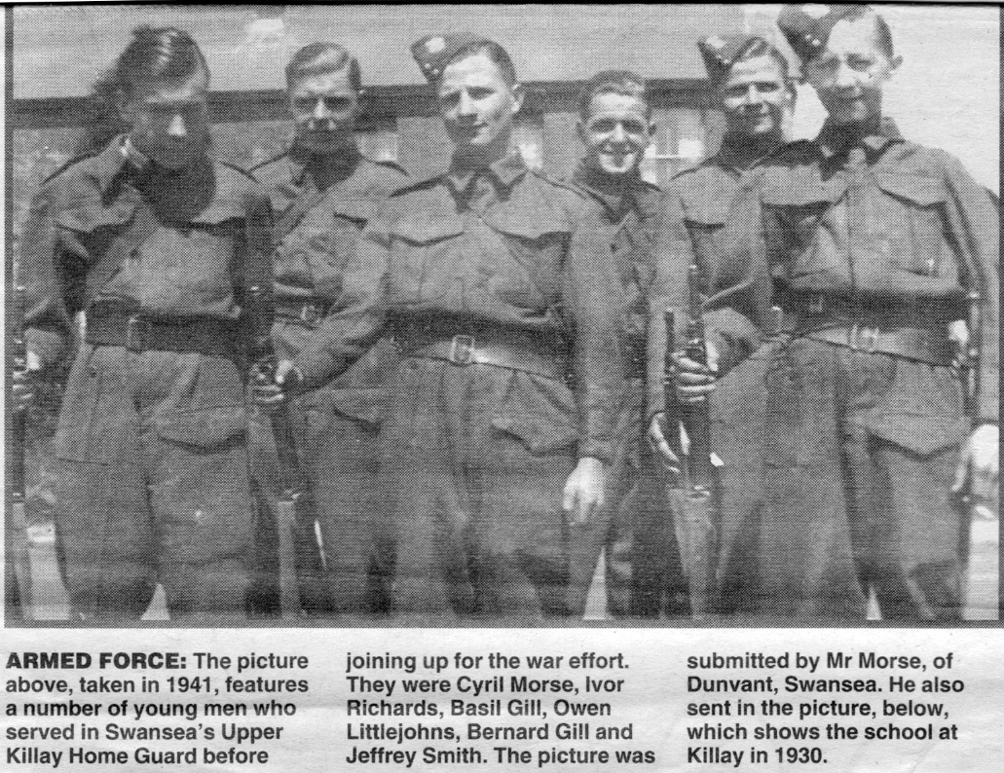
It wouldn’t surprise me to find out that Owen was doing something vehicle related in the Home Guard (which we know he was in from a newspaper clipping). As it would happen, Stanley Benjamin Littlejohns, their cousin – who would die a prisoner of war after the fall of Singapore – was also a driver, as was Uncle Bill Hole.
Penarth and onwards
At the time of Cled’s enlistment he was at No.1 Recruits Centre at Penarth. During the war, many of its hotels and large houses were requisitioned by the RAF. Rather than living in one huge camp, recruits were dispersed around the town and marched between accommodation, parade grounds and classrooms. No. 1 Recruits Centre had been based there since 1941, headquartered at 31 Victoria Road under No. 24 Group.
Throughout this write up we will come across terms like Wing, Group etc so here is a quick overview of those terms:
Groups were a massive, regional command subdivision. In RAF Hierarchy it would function like this (roughly) Command (fighter/bomber) > Group (regional) > Wings (collection of squadrons)
The maintenance/support apparatus for the RAF could be tied to Commands, Groups, Wings or even maintenance/support depots and lastly Airfields/Stations.
Cled would remain in Penarth from August 1942, for 2 months, leaving on the 8th of October 1942. During his days at Penarth, he would have attended morning parade before spending much of the day on drill, marching, physical training, and learning RAF discipline, customs, and rank structure. He would also have attended lectures on subjects such as security, first aid, gas defence, and military procedure, received medical and dental checks, and learned basic rifle handling and service routines. Much time was devoted to cleaning kit, polishing boots and brass, and preparing for inspections, with free time in the evenings often spent writing letters or, if leave was granted, visiting Penarth or nearby Cardiff. The last of the blitz bombing raids on Cardiff was in May of 1942, so the city would have been recovering and rebuilding from the air raids whilst Cled was there.
After his time at Penarth, Cled was first moved on the 8th of October 1942 to the No. 14 Recruits Centre (14 R.C.) and was then assigned to the 3060 Servicing Echelon at RAF Ford, in Sussex. He would have spent his time driving RAF vehicles, doing maintenance, practising convoy discipline, all whilst carrying out station transport duties and working alongside operational servicing units at the airfield. As part of his role as a driver, it’s safe to assume he would have driven out to places and back to base, so he would have driven all around the areas where he was stationed. This could have been delivering to units, docks, railheads, supply depots, RAF stations etc – basically whatever was needed.
He stayed with 14 Recruits Centre for a month before moving to 12 School of Technical Training on the 19th of November 1942. The school was based at Melksham, Wiltshire under No 24 Training Group. His time here would have been spent carrying on his learning from earlier but more of a full deep dive into all the different vehicles he would/could encounter in the war. Whilst at the School on the 31st of December 1942 Cled has his trade indicated as Driver Mechanical Transport – under/training.
1943 – Finishing Training and Embarking
On the 28th of January 1943, only a few months after arriving Cled was off again, first to the No 1 Personnel Despatch Centre at RAF West Kirby and then onto the No 5 Personnel Despatch Centre at RAF Padgate, Warrington – arriving there on the 15th of February. The Personnel Despatch Centres were the mechanism by which troops were processed before being sent abroad. Cled was to leave for India on the 21st of February 1943.
I wonder when Cled realised he was to be posted abroad…
It’s safe to assume that due to operation secrecy he wouldn’t have known where he was going until he was on ship, but there must have been a period where the men were told to take one last trip home, say their goodbyes, make Wills, etc.
In total Cled had only been in the RAF for less than 190 days before embarking for India. By contrast, for his brother William, it was around 850 days between signing up and disembarking for India.